jmgoyder

wings and things

Values

Ming and have both sought psychological help over the last few years and one of the most difficult questions to answer is “what are your values?” I think this is a very tricky question, but an important one. It is also a question that I have found extremely challenging to answer.

Stereotypical answers might be: health, family, financially okay, great relationships, good job, political stability, beautiful kids, long life etc. but these are too vague and I don’t like my own vagueness.

Perhaps the question should be rephrased to “what do I value?” This turns the noun ‘value’ into the verb ‘value’ and, in my opinion, makes the question easier to answer. For example, I know what I value most, whereas I can’t quite pinpoint what my values are.

What do I value most?

  • Kindness (the giving and receiving of);
  • My son’s growing wisdom;
  • Anthony’s smile;
  • Authentic relationships with family and friends;
  • Humour;
  • My ability to write about dementia;
  • The new puppy, Pip;
  • Honesty; and
  • Salad.

I haven’t been very good lately at looking after my physical, psychological and emotional health but, like many, I baulk at self-helpy stuff. But there is nothing wrong with self-help! After all, the best way of helping others, which is something I feel passionate about, is to get yourself on track first, surely.

Ming comes home tomorrow from a 6-day intensive beginning to a diploma in psychology which he will complete in around 15 months. He seems to have found his niche and I can’t wait to hear about all of it; we have already had some fascinating phone conversations.

Even pre-dementia, Anthony would never have understood Ming’s passion for helping people; nevertheless he would be so proud if he understood. Often Ants still thinks Ming is a toddler so when this great big man steps into the nursing home room it can be a bit confusing.

Ah yes – other things I value:

  • Laughter;
  • Still being in love; and
  • Ming.
18 Comments »

Dementia dilemmas: Silence

Anthony is gradually losing his ability to speak clearly and coherently; his voice is soft and croaky and his sentences are sometimes incoherent and don’t make sense. I have to face the fact that the ‘dementia dialogues’ that I write from time to time will no longer be possible as Anthony’s vocal and cognitive skills decline.

Of course, not being able to write our funny little conversations isn’t at all significant in the face of Anthony’s impending silence. I have to admit that I am dreading the possibility that he may stop speaking altogether, but many people with dementia do.

I will miss his one-liners, his ‘I love you too’, and even his sometimes impossible-to-interpret statements like “That’s part of its beautifulness, Jules” when he was referring to something I didn’t understand a few weeks ago.

If this anticipated silence becomes a reality, how will he and I both cope? At the moment, I can easily mind-read and interpret what he is trying to say, so I can affirm that I understand, even if he is asking me to get the cows in, find the car, book the restaurant, give Ming a paddock, cook mornay, take him to Tasmania, visit his mother ….

Over the last weeks, sentences have diminished to single words and sometimes even the single words are unrecognisable as words; sometimes these are just faint sounds. When I can’t understand what he is trying to say, I will ask him to clear his throat and repeat what he just said. Usually my lack of understanding elicits a faint smile or a slight shaking of his head as if to say he has given up and then he will lapse into sleep again.

It is hard to reconcile this diminutive, quiet man with the loud, boisterous, vociferous presence he used to be. On the other hand, Anthony still has an amazing vitality, a spark; he still has a presence. He is popular with staff and he probably has more visitors than most. When a group of us happen to converge in his nursing home room, his delight is obvious but is not necessarily vocal.

Perhaps he will never lose his ability to speak entirely, but, just in case he does, I am preparing myself for conversations that only require a ‘yes’ or a ‘no’; a shaking or nodding of the head; a squeeze of the hand; eye contact; a hug; a kiss; tears and laughter….There are lots of ways to communicate that don’t depend on speech.

Nevertheless, I already find the sound of Anthony’s silent days incredibly challenging. It’s not tragic, or particularly depressing; it’s just the way it is and might be. Yesterday and tomorrow don’t really matter when it comes to today.

So, from now on – ever single today – I will treasure every single word that Anthony is able to utter. But I will also embrace silence.

[Knowing Ants, he will probably come out with an eloquent paragraph when I am least expecting it!]

12 Comments »

Dementia and misrecognition

Ming has been the first of the two of us to be misrecognised by Anthony because Ants keeps forgetting that Ming is now a 23-year-old adult, and not the toddler he often thinks he sees in his nursing home room.

Anthony always knows me but, on the other hand sometimes, when I am sitting next to him, he will talk about Julie to me not quite realising that I am Julie.

Neither of these misrecognitions is tragic – well, they don’t need to be! After all, Anthony is not deliberately misrecognising Ming by thinking Ming is one of Anthony’s numerous nephews. Of course the first time this happened Ming was understandably annoyed and hurt but, since then, he goes with the flow and often says, in his big, booming voice, “I am your son, Dad!”

I am quite prepared for the day that Anthony might not know who I am at all; after all, I know how dementia works and how it manifests itself differently for each and every individual. Why would I be hurt by something that can’t be helped? If Anthony’s dementia worsens, which of course it will, then it may be inevitable that one day he won’t know who the hell I am. I am ready for that.

I’ve said this before but will say it again; if Anthony stops knowing who I am, it doesn’t matter because I will always know who he is. This misrecognition thing that happens with dementia doesn’t have to be seen as a tragedy; after all, the person with dementia has absolutely no intention of breaking your heart by not knowing who you are. You can still be the most trusted, and most loving person, in his/her life.

Anthony: Where is Jules?

Me: Right here, Ants.

8 Comments »

“Look after yourself.”

I used to absolutely hate it when people said this to me. Over many years, so many people have said the following kinds of things:

You need to look after yourself, Julie!

You should get out more, Julie!

You’re exhausting yourself, Julie!

You don’t have to visit Anthony every day, Julie!

You should sell the farm, Julie!

You should smoke pot, Julie!

You need to get a life again, Julie!

This sort of well-meant advice enraged me at the time, and I resisted it, but now I am beginning to think that maybe – just maybe – it is time to make a bit of a change. A friend visited Ants the other day and, when this friend asked Anthony how I was, Anthony said, despondently, that he hadn’t seen me for days. But I had seen him the previous day! Admittedly I haven’t been into the nursing home as much as usual due to the new puppy (who, having only just been vaccinated, can’t be taken anywhere until next Friday due to the parvovirus outbreak), but it was frustrating to find out that Anthony hadn’t remembered my previous day’s visit.

And this is my dilemma: on some sensory level, Anthony notices my absence and conflates the single days I don’t visit into several days, so feels neglected. On the other hand, I might be with him day after day and he will still forget and this is a cognitive/time issue. This is an impossible conundrum that I wrestle with constantly but, due to the puppy situation, I have seen less of Anthony than usual over the last month.

The fact that, despite his now advanced Dementia, Anthony has noticed my absence, is terribly upsetting for me. On the other hand, I am beginning to realise that I actually do need to care for myself better. But I had to come to this realisation by myself and not succumb to all the ‘should’ advice.

When Ants was home and Ming was little we had an idyllic little triangle of love for each other; it was magic and it went on and on, for years and years, despite the onset of Anthony’s many illnesses (including kidney cancer in the first year of our marriage).

I will never, ever abandon him and not visit, but perhaps it really is time to re-find myself, look after myself. If I can learn how to do this better, I will be more effective in the carer support groups I am helping to facilitate.

Look after yourself.

12 Comments »

Dementia and deceit

I absolutely love the idea of fabulation (making up stories), especially in the context of Dementia. After all, if Anthony can tell me that there are calves frolicking outside the window of his nursing home room (not true), surely I, too, am allowed to fabulate. The only difference, I guess, is that I am doing it knowingly; I am lying on purpose in order to comfort him, to make him happy.

For example:

Anthony: I fixed all the fences and the trough leaks this morning.

Me: Is that why you’re so exhausted?

Anthony: Yes, and I rode the bicycle.

Me: How far?

Anthony: About 20 miles!

Me: Bloody hell, Ants, you are overdoing it!

Anthony: I know.

Me: Ming can do some of those jobs for you – he wants to.

Anthony: He’s too young, Jules.

Me: He’s 23, Ants.

Anthony: That’s someone else. Our son is too little.

Me: Well, when he grows up he wants to be just like you.

Anthony: Oh.

Me: Ants, remember that lotto ticket we bought last week?

Anthony: No.

Me: Well we won a lot of money.

Anthony: How much?

Me: Thousands! We will never have to worry about money again. Isn’t it wonderful!

Anthony: Are you sure?

Me: Absolutely, so I am going to take the money and run off to Hawaii!

Anthony: You would never leave me.

Me: Yeah, I was just kidding, Ants. So what do you want me to do with all this money?

Anthony: Put it in the freezer.

There is no bicycle, no money and very little reality to this kind of conversation but it helps! Sometimes I feel like an actor in a play where ad-libbing is the norm. My fabulatory conversations with Ants often resemble something Samuel Beckett might have written.

My attitude may seem controversial but, as a farmer, Ants has always been worried about money, so it seems logical to fabulate the idea that there is plenty. Why not? It is a comfortable lie and now he often greets me with the question of how much is in the bank account. If I told him that his pension was not quite covering his nursing home costs and that I was eating into my superannuation to survive, he would be worried.

I don’t want him to be worried and I love the way he responds to the news of our (fictitious) burgeoning bank account. I also love the way he is under the impression that he is still farming, and farming successfully.

Anthony: That was a good party.

Me: Which one?

Anthony: The wedding.

Me: Oh, yes, it was brilliant!

Sometimes I feel acutely the surreal experiences of having been privy to these fabulations that Anthony thinks have happened in reality. He doesn’t know that he has Dementia and he often doesn’t realise he is in a nursing home.

One thing that is absolutely certain in our relationship, and that is free of fabulation, is that we love each other very much.

9 Comments »

My mother is a poem

My mother, Meg, is 82 and the age itself conjures images of white hair, stooped posture, decrepitude, and yet she defies all of this with her beautiful, generous presence in so many of our lives. She battles deafness, combats macular degeneration of the eyes, and has overcome breast cancer, multiple broken bones, grief and trauma, with the most incredible resilience I have ever seen in another human being.

Not only that, Meg is always willing to listen – even to criticism. She does listening better than anyone I know and her support of her three children, eleven grandchildren, and the so-far four great-grandchildren, is solid and unwavering.

Sometimes she and I get a bit impatient with each other because, even though we are so mutually attuned, we are very different. Meg is impetuous, fast and good at multi-tasking whereas I am cautious, ponderous and sometimes timid. Nevertheless, we share the same heart; we miss the same person (my dad who died so young); and we want the very best for the whole ever-extending family.

Below is my mother’s poem about death:

MARY

Her hand,

a strong but ageing hand,

slipped momentarily through

a curtain made of gossamer,

took hold

of both of mine,

and pulled me through.

Her smile a twinkle

and her voice like

ripples in a stream.

“Come, meet my son.

He’s waiting over there.”

And, arm in arm,

we moved

to His embrace.

My mother, Meg, is 82 and the age itself can often lead to intermittent thoughts and wonderings about death. This poem dispels the fear of death and, for me, breaks through the discomfort of talking about death.

My mother is a poem. We all are.


18 Comments »

New kid on the block (and the reason I haven’t been blogging lately)

img_0758

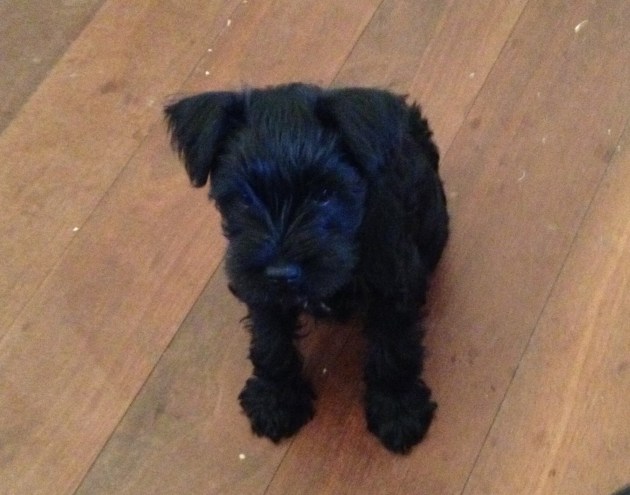
Well, here she is – Pip – a miniature schnauzer who is just eight weeks old. Once she has had her next vaccinations, I will be able to take her with me to see Anthony and other people.

The story behind her name: years before Anthony and I were married, I lived in a little cottage a few kilometres from his farm. I was undertaking my first year of university studies and feeling, I guess, a bit isolated. I was also suffering a severe case of ongoing unrequited love for this beautiful but idiotic older man who, instead of proposing, bought me a miniature dachshund puppy that we called Pip.

That Pip was the most beautiful gift, and the best friend I had ever had until she died many years later.

I was recently reminded (via a photo) of the special bond I had with that first Pip and how her company helped me through doing all of those assignments in that small cottage all alone. I was only in my 20s then and terribly naïve; I couldn’t understand why Anthony didn’t love me back. It is only in retrospect that I realise how taboo it would have been for him, a middle-aged farmer, to contemplate a romance with me.

So, instead, he gave me Pip.

And now we have a new Pip and I am, once again, not alone.

25 Comments »

Dementia and hallucinations

Yes, I am still working through past blog entries in order to formulate a book, but I keep getting distracted by the present.

I don’t think even the scientists know whether the hallucinations people with Dementia experience, especially those with Parkinson’s Disease Dementia, are part of the actual condition, or a side-effect of the medications.

Tractors pulling Anthony’s trees down; long-lost friends and family (some deceased) visiting; a multitude of strange children making mischief; a room full of calves and dogs; a pirate ship; the strange ‘teacher’; the terrifying kidnappers; the wondering where I am ….

….even when I am right there.

After the terrible fright of a few months ago, when I thought Anthony was going to die, he has resurrected and, in his own words, is “better now.”

This month marks five years that Anthony has been in the high care section of the nursing home. He has outlived all of his prognoses (advanced prostate cancer, advanced PD) by years; he has somehow survived liver disease and kidney cancer. The Dementia component has been there all along but has only become noticeable over the last couple of years.

Dementia is, of course, very confusing for the person who has it but it is also confusing for the person caring for the person with Dementia. Moments – even hours – of lucidity can sometimes be punctuated with such bizarre stories that the carers are at a loss as to how to respond.

Even me, who loves him so much. Even me.

Recently, I have become so tired: of pretending I have to go to work (as way of leaving); of missing him; of this never-ending grief; of wondering whether he is okay when I’m not there. I have had to let go of the latter for my own sanity but I still worry about whether he is too hot or too cold (these thermostatic problems were the bane of my life when Ants was still at home.)

And what about Ming – our now 23-year-old son? Anthony sometimes mistakes him for a nephew and doesn’t recognise him as his only child. I don’t know how this feels as Anthony always recognises me, even if he is confused.

Ming is often ‘seen’ by Anthony in the corner of his nursing home room – as a toddler – and this particular hallucination gives Anthony immense delight. So I go along with it; what else can I do?

Perhaps the trick with Dementia-induced hallucinations is to go with the flow unless the particular hallucination is troubling.

Me: Nobody is cutting your trees down, Ants!

Anthony: Yes, he is – just look!

Me: I think it might just be your imagination and the Parkinson’s Disease?

Anthony: You always say that.

Me: Do you want me to get Ming to check it out?

Anthony: He’s too little, Jules.

Me: No, he’s a man now, Ants, and he can fix everything!

It is perhaps the ongoing, repetitive loop of the same conversation that can sometimes exhaust the carer. On the other hand, it’s familiar territory and I love to insert a bit of humour into the same old conversation and can sometimes make Anthony smile by saying “Are you totally insane?”

Yeah, bleak humour can sometimes be useful when it comes to Dementia-induced hallucinations.

And I am, and will always be, grateful to Anthony for teaching me so much about this often misunderstood and complicated condition.


13 Comments »

The Anthony story: Chapter 1.1

ENTERING LIFE IN A NURSING HOME

I remember being absolutely terrified and, when I look back, I realise that my terror was simply a reflection of Anthony’s fear of the unknown I guess. The view from his window was, and still is, of a lawned area which I am so grateful for because now that is where he ‘sees’ people and livestock and dogs, via his hallucinations.

He had been hospitalised so many times during 2011, that it was a surprise to me that there was no television. Hospital rooms always have televisions and Anthony was used to watching the news channels. I didn’t want to leave him in such quiet emptiness so I raced down to the closest shop and bought him a television and got it working that day. I remember feeling a sense of desperate urgency that he would have something/anything to distract him from the fact that he was being left there.

January 2012: The bed looked so small, the wardrobe looked so large, the walls looked paint-chipped in places, but all in all, it was satisfactory. I can’t remember who did the admission interview and Anthony, of course, no longer remembers any of it, but at the time it seemed a terse introduction to a respite situation that, just weeks later, would become permanent.

During those interim weeks between respite and permanency, I was busy with looking after Ming in Perth, 200 kms away – his pre-operative preparations, the spinal surgery itself, and his post-operative recovery. I remember racing back and forth from the hospital in Perth to the nursing home in Bunbury and reassuring Anthony that Ming was fine. Back then, despite Anthony having very clear signs of Dementia, he understood what was going on and why he had to be in the nursing home. Nevertheless,  he argued with me that he would be fine at home on his own and I had to keep reminding him of his falls (back then I only had to turn my back for a second and I would find him toppled on the ground).

I don’t think there was any question of Anthony being permanently admitted to the nursing home at that time. Certainly there was no question that Ming’s post-operative health would be my priority. So the fact that Anthony’s nursing home room became available in a forever way was both a relief and a shock. Anthony and I had numerous discussions over the week we had to make the decision and all of those conversations are now a blur to me. But I do remember him conceding in the end; his pragmatism took over and he didn’t shed a tear as we signed the forms. I can hardly bear to think of how abandoned he must have felt, but I do remember how the hot tears burned through my body, my eyes, my skin, during that first year.

It’s so different now! The Dementia component of Anthony’s PDD has made it easier for me to convince him that all is well on the farm, to thank him for fixing the fences yesterday, to talk about the party we had last night, to ask his advice about toilet-training little Ming, to fixing pumps, how to cook his mother’s salmon mornay, or do I look better in a skirt or jeans.

Whenever you enter a virtual game, emerge from a dream, or find yourself identifying with a character in a novel, or a blog, or a movie, you are going to come face-to-face with the difference between real and unreal.

Yesterday Anthony thought he saw a close neighbour, Mick, on the lawned area outside his room. As usual I went along with this. Then, this morning, I bumped into Mick at the local shop (I hadn’t seen him for years.) Such a strange and wonderful coincidence!

Yes, Dementia has its tragic sides, of course, and every single individual’s experience of having this disease is different. I have learned how going with the flow is sometimes not enough; sometimes you just have to go with the moment-by-moment situation.

When Anthony says, “I don’t understand what’s going on, Jules” it breaks my heart. But when he says, “I’m glad we painted that wall blue” (the wall behind his television), it is the perfect opportunity for me to begin a conversation, no matter how bizarre, and we can even have a laugh.

After all, when the ‘now’ Anthony was the ‘then’ Anthony, he would never have had a wall painted blue.


7 Comments »

The Anthony story: Chapter 1

Having decided to write a book about my husband’s Parkinson’s disease dementia (PDD) and how our son and I have dealt with Anthony’s condition, I reluctantly went back to blog entries.

My reluctance was only due to the fact that we are now coping well, so I didn’t particularly want to re-visit the traumas of Anthony’s escalating disease, his admission to the nursing home, and the hearbreaks of that era.

Nevertheless, I did go back in time, via my blog, to discover that during the December of 2011, Anthony was in a Perth hospital for the third time, with a specialist trying to get his PD medications ‘right’. Not long after he came home, he had what I now know was a TIA (a mini-stroke) and I called the ambulance. The hospital experience was frightening as Anthony became totally disorientated.

As Ming was due for major spinal surgery for scoliosis in early February, we gratefully accepted the respite room, at a local nursing home, for Anthony from the 4th January, 2012. This was a godsend as I knew I could no longer leave Ants alone on the farm and I needed to be in Perth to look after Ming post-op.

On January 24, 2012, Anthony’s respite room became available permanently and we had a week to make that decision. Even thought it was a mutual decision, between Ming, Anthony and me, and we all agreed, the pain of this decision was ghastly and, for me particularly, agonising.

I wish that I had known then what I know now, about how to make this experience better. Back then, Anthony wasn’t as confused as he is now with Dementia, so he must have felt abandoned regardless of how many hugs and words of comfort I gave him.

Today, he removed my hand from inside his and carefully placed it on his table.

“Why did you discard my hand, Ants?” I asked

“I thought it might need a rest, Jules.”


15 Comments »