When most people think of Parkinson’s disease, they think of dyskinesia which is the involuntary movements, tremors and tics that are symptomatic of the disease. Anthony’s version (called ‘Parkinsonism’) is not like this. Instead, his disease is characterized by bradykinesia – the chronic slowing down of movement.
Big words to match small, sometimes unnoticeable, symptoms. To begin with, many years ago now, I deliberately tripped over these words and many, many more – like ‘idiopathic’, ‘hypokinesia’, ‘ataxia’, ‘dysphasia’, ‘mirographia’, ‘akinesia’, ‘palilalia’ – just as Anthony was undeliberately tripping, literally, over his own feet. I didn’t want to know what those words meant back then; I didn’t want to know what was coming. The glossary below is for those who are curious:
http://www.webmd.com/parkinsons-disease/parkinsons-glossary
The first signs were subtle like Anthony’s inability to open the vegemite jar, and his reluctance to drive the car. But then the signs became more dramatic: Anthony’s increasing stoop, strange gait, the drooling, getting stuck in the back yard and being unable to walk back to the house, the hallucinations, me coming home from the local shop to find him face-down in the vegetable patch, Silver chain home assistance, hospitalisations, drug experiments, nightly toiletting shifts with Ming, Anthony’s apologies, his gradual loss of control over his body, his shame and frustration….
All of these things jigsawed into each other crookedly, violently sometimes; we could not get the jigsaw back together again no matter how hard we tried, because already there were too many pieces missing. A simpler jigsaw needed to be built and learning what those many big words meant has helped frame the centre of this new jigsaw, the centre being Anthony himself of course, and his incredible resilience and acceptance.
One of the most wonderful things that has happened lately is that just when I thought Ants had become totally immobile, the staff told me that his nephew, P, visited on the weekend and Ants was able to use his walker to go outside into the sunshine with P. This nephew visits Ants every weekend, but he doesn’t do this out of duty, he does it because he loves Anthony (and I have yet to meet anyone who doesn’t).
Another wonderful thing is that just when I thought Ants had completely lost his ability to speak coherently, I arrived and rushed to give him a kiss yesterday and he smiled his newfound smile and this was our conversation:
Anthony: You are a wonderful person!
Me: Why?
Anthony: Well, you always find yourself in the most extraordinary places!
Me: What – like here?
Anthony: Yes! You always find me, Jules!
The fact that Anthony’s eloquence, mobility and ability to smile all seem to have come back to some extent, after a long period of struggling with all of these things, is quite strange. I write down all of his extraordinary sentences and am thrilled when he can actually walk; as for the smile, it is almost as if my determination to get that brilliant smile back via any means – including slapstick antics, banter, his favourite comedy series, and just laughing my raucous laugh – has somehow tickled his facial muscles into action again. And, like any exercise of any muscle, the more Anthony smiles, the more able he is to smile. Ming has noticed this and so have the staff and everyone is surprised and delighted.
Does this mean Anthony is getting better? Of course not, but it’s a very interesting turn of events made even more interesting by a conversation I had with a resident whose room is two doors away from Anthony’s. She beckoned me over to where she was sitting in her wheelchair and whispered loudly, “I’ve heard a rumour that Anthony is getting most of the attention these days and is the most popular, but don’t let it bother you because we are all treated well.” Then she guffawed enigmatically and I have yet to decode what she meant.
The other day I told Anthony about Gutsy being killed and he kept reaching out his hand to put it on top of mine.
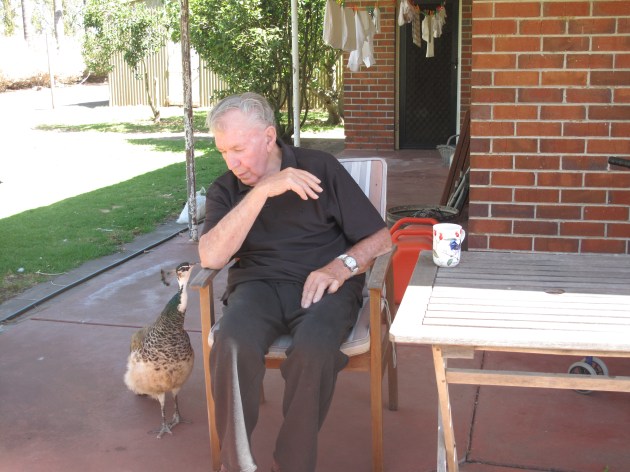
Over and over and over again – his hand, found underneath the blanket that is always on his knees, and my hand bringing his out into the cold air of a heated room, and his hand finding my hand – a jigsaw of interlaced fingers, a smile, a repeated hand tap.
But, when I was telling Ming about this tonight he said he’d seen Anthony earlier today and Anthony was so confused and blah that he almost didn’t recognise Ming!
Ming: I get it with the smile thing, Mum, but Dad was pretty bad this afternoon.
Me: So should we give up then?
Ming: No!
Me: No?
Ming: I don’t know.
Me: I don’t know either.
The above is not an exact rendition of our conversation but, rather, a compression of many conversations over many months/years. Ming, at 21, is always going to be the vital jigsaw piece that has the elasticity to fit right back in and complete the puzzle, or else wing to and fro.
Par
kins
on
ism
saw
jig












 jmgoyder